Is chain link fencing a good fit for Kailua-Kona properties?
Chain link fencing is one of the best fits for Kailua-Kona properties. It stands up to the coastal salt air better than untreated wood, costs less to install and maintain than most other fence types, and gives you clear sight lines for security without blocking the breeze. Galvanized or vinyl-coated chain link handles the Kona coast's humidity and salt exposure for decades with minimal upkeep.
How much does chain link fence installation cost on the Big Island?
Chain link fence installation on the Big Island varies based on the height, gauge, coating, and the terrain being fenced — particularly lava rock, which requires specialized drilling equipment. Because every property is different, the most reliable way to get a real number is a free on-site estimate. On The Line Fencing offers free estimates across Kailua-Kona and the entire Big Island, Monday through Friday.
How long does chain link fence installation take in Kailua-Kona?
Most residential chain link fence installations in Kailua-Kona take one to three days, depending on the total footage, gate count, and ground conditions. Properties with extensive lava rock may take a bit longer because the rock has to be drilled or core-bored before posts can be set. A professional crew with the right equipment handles this without cutting corners on post depth or spacing.
If you're shopping for chain link fencing in Kailua-Kona, this guide covers everything that matters — why chain link makes sense on the Kona side, how installation actually works in lava-rock terrain, and what to look for in a contractor before you sign anything.
Why Chain Link Is So Popular on the Kona Side
The Kona coast gets a lot of sun, steady trade winds, and salt air rolling in off the Pacific. That combination is hard on fencing materials. Wood rots faster here than on the mainland. Wrought iron and untreated steel rust. Vinyl holds up better, but it can fade and become brittle under intense UV over time.
Galvanized chain link is built for exactly this kind of environment. The zinc coating resists rust and salt corrosion, and if you step up to vinyl-coated chain link — typically in black or green — you get an extra layer of protection plus a cleaner look that blends into the landscape. It's the fence type you'll see around livestock pastures from Captain Cook up to Waimea, along commercial yards in the Kona industrial area, and on residential lots from Holualoa down to Kealakekua.
There's also a practical security angle. On larger parcels in areas like Kainaliu or Honaunau, chain link keeps livestock in and predators out without blocking sight lines. On residential lots closer to Kailua-Kona's downtown, it defines the property boundary clearly while still letting you see what's happening on the other side. For pool enclosures, swimming pool fences built with chain link meet most safety codes and hold up to the poolside moisture that destroys wood framing fast.
What Does Proper Installation Look Like in Lava-Rock Terrain?
This is where Kona jobs differ from a standard mainland fence install, and it's the main reason you want an experienced local contractor rather than someone guessing at how deep a post hole should be.
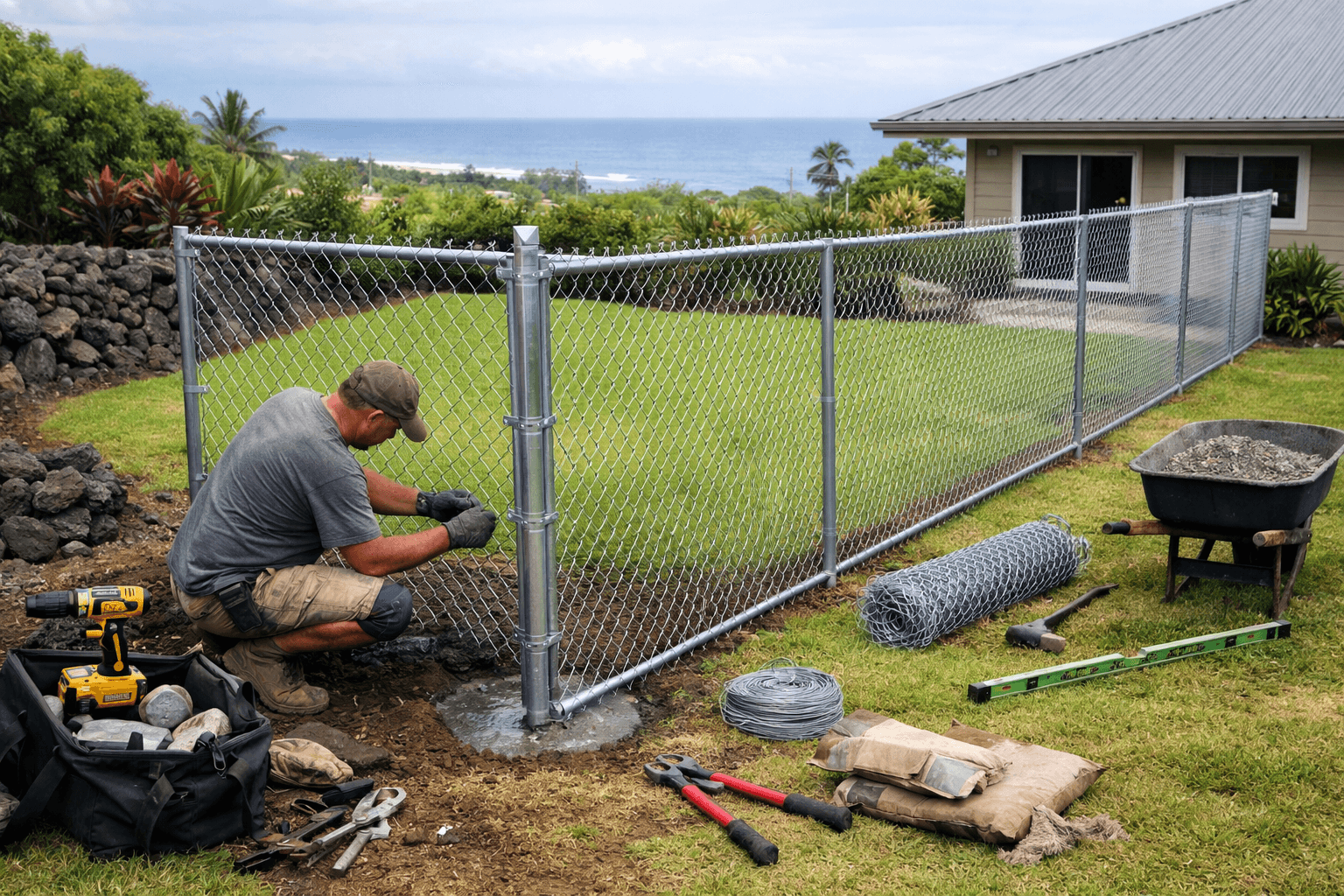
Much of the Kailua-Kona area — and a good stretch running south toward Ocean View and Pahoa — sits on old lava flows. The surface can look like soil but hit solid pahoehoe or a'a rock just a few inches down. Digging post holes by hand or with a standard auger doesn't work. The right approach:
- Core drilling or hammer drilling into the lava to the required depth for the post gauge and fence height.
- Setting posts in concrete, even in lava, so they're anchored against wind load and won't shift over time.
- Adjusting post spacing to account for uneven terrain so the fabric hangs taut without low spots animals or people can push under.
- Using terminal posts (corner, end, and gate posts) that are heavier gauge than line posts — these carry the real tension load.
Skip any of those steps and you'll have a fence that leans, sags, or pulls free from the ground within a few years. On The Line Fencing has been doing this work across the Big Island for over 20 years, including plenty of lava-field installs where the prep work is as important as the fence itself.
Chain Link vs. Other Fence Types for Kona Properties
| Factor | Chain Link (galvanized / vinyl-coated) | Wood or Untreated Metal |
|---|---|---|
| Salt air resistance | High — zinc and vinyl coatings resist corrosion | Low — rots or rusts faster in coastal humidity |
| Maintenance | Minimal — rinse occasionally, inspect hardware | Regular painting, sealing, or rust treatment needed |
| Visibility / security | Full sight lines — you see through it | Solid panel blocks view in both directions |
| Livestock / field use | Excellent — heavy gauge options for large animals | Not ideal — gaps, splinters, and rot risks |
| Lava-rock installation | Works well with proper drilling and concrete setting | Same challenge — no fence type avoids the rock |
- Salt air resistance: Chain link with zinc or vinyl coating holds up — wood rots and bare metal rusts faster on the coast.
- Maintenance: Chain link needs little attention — wood and untreated metal need regular sealing or painting.
- Visibility: Chain link lets you see through — solid panels block the view in both directions.
- Livestock use: Heavy-gauge chain link handles large animals — wood isn't ideal for field fencing.
- Lava terrain: Every fence type faces the same rock — the difference is whether your installer knows how to handle it.
What Heights and Gauges Should You Choose?
Fence height and wire gauge depend on what you're trying to accomplish. A general guide according to the Chain Link Fence Manufacturers Institute:
- 4-foot, 11-gauge — standard residential boundary, yard containment for small dogs.
- 5- to 6-foot, 9-gauge — privacy and security for residential lots, commercial yards, and pet kennels.
- 6- to 8-foot, 6-gauge — high-security applications, commercial properties, and tennis court enclosures.
- Field fence with barbed wire topper — pasture and livestock applications common across Honaunau, Captain Cook, and rural South Kona parcels.
Going with a heavier gauge costs a bit more upfront but adds years of life, especially in the coastal salt environment. If you're also adding a gate — gate installation and automatic openers pair well with chain link and can be spec'd at the same time as the fence — the gate posts need to be set even deeper and in heavier gauge steel to carry the swing or slide load.
According to the National Fence Association, post depth should be at least one-third of the total post length — a rule that's even more important in high-wind coastal areas and lava-rock soil where lateral load matters.
How to Get Ready Before the Crew Shows Up
A little prep on your end makes the install go faster and cleaner. Before the crew arrives:
- Mark your property line clearly — survey stakes or a recent plat map help avoid disputes with neighbors later.
- Clear the fence line of brush, overgrown vegetation, and debris. On The Line Fencing offers fence line clearing if you need that handled professionally.
- Note where your utilities run. Call 811 (Hawaii One Call) before any digging — this is required by law and keeps your crew safe.
- Decide where gates go before installation day — moving a gate location after posts are set in concrete isn't impossible, but it adds time and work.
The more clearly you can communicate what you want at the estimate visit, the smoother the project goes. That's always been the approach here — we're not happy until you are thrilled with the final result, and that starts with making sure expectations are set right from the first conversation.
Frequently Asked Questions
Can chain link fence be installed directly into lava rock in Kailua-Kona?
Yes, but it requires core drilling or hammer drilling into the lava — a standard auger won't cut it. Posts are then set in concrete inside the drilled holes to ensure they're fully anchored. Skipping this step or setting posts too shallow results in leaning or shifting posts within a few years, especially with the wind load common on the Kona coast.
What gauge chain link wire is best for coastal areas like Kona?
For coastal properties on the Big Island, 9-gauge galvanized or vinyl-coated chain link is a solid standard choice for residential use. The heavier the gauge number goes down (e.g., 6-gauge), the thicker and stronger the wire. In salt-air environments, the vinyl coating gives you an additional layer of corrosion protection on top of the galvanizing and extends the fence's useful life significantly.
Do I need a permit to install a chain link fence in Kailua-Kona?
Permit requirements in Hawaii County depend on the fence height and location on the property. Many standard residential fences under a certain height don't require a permit, but fences near property lines, roads, or in special zoning areas may. It's always best to check with the Hawaii County Department of Public Works before starting any fence project to confirm current requirements for your specific parcel.
How long will a galvanized chain link fence last in Kona's salt air?
A properly installed galvanized chain link fence typically lasts 20 to 30 years in normal conditions. In coastal salt-air environments like Kailua-Kona, vinyl-coated chain link adds extra longevity by sealing the wire against moisture and salt corrosion. Regular rinsing to remove salt buildup — especially after periods of high wind — helps maintain the coating and keeps the fence looking clean.
Does On The Line Fencing serve areas outside of Kailua-Kona?
Yes. On The Line Fencing is based in Hilo and serves the entire Big Island, including Kailua-Kona, Waimea, Captain Cook, Pahoa, Honoka'a, Ocean View, and dozens of other communities across the island. Whether you're in town or on a rural parcel in South Kona or Puna, the crew travels to the job and brings the right equipment for the terrain.
Ready to get your property fenced the right way? On The Line Fencing has been doing this work on the Big Island for over 20 years — family-owned, locally based, and standing behind every job. Call us today at 808-854-0213 for a free estimate. We're available Monday through Friday, 8:00am to 4:30pm, or you can reach out through the contact form on our website anytime.